


America at 250: The Desk, the Declaration, and the Legal Work Behind Independence


If Thomas Jefferson’s portable desk could speak, it might not begin with fireworks.
It might begin with the scrape of a chair, the weight of a quiet room in Philadelphia, the sound of paper unfolding, the smell of ink, and the pressure of choosing words carefully — because words, once written, could become a nation’s future.
In 1776, Jefferson used a small portable desk of his own design to draft the Declaration of Independence.The Smithsonian describes it as a portable desk with a hinged writing board and a locking drawer for papers, pens, and an inkwell. It was not grand or ceremonial. It was a working surface — a place for language, revision, and ideals that had to become clear enough to be read, debated, challenged, adopted, and defended.

That detail still matters 250 years later.
Independence was not only declared in emotion. It was shaped through language, law, structure, and responsibility.
Independence Began With Words, But It Could Not End There
Picture the desk — not as a museum object, but as a practical tool in the middle of a historic burden.
A writing board.
A drawer for papers, pens, and an inkwell.
A surface small enough to carry, but strong enough to hold the first draft of an idea that would change the world.
Monticello identifies Jefferson’s writing desk as the one on which he wrote the Declaration of Independence, noting that it was made from his own drawing by a Philadelphia cabinetmaker.
On that desk, words had to do more than inspire. They had to explain, accuse, persuade, and declare. The Declaration of Independence was not simply a patriotic statement. It was an argument. It listed grievances. It explained why separation from Great Britain had become necessary. It gave language to a decision that carried enormous risk.
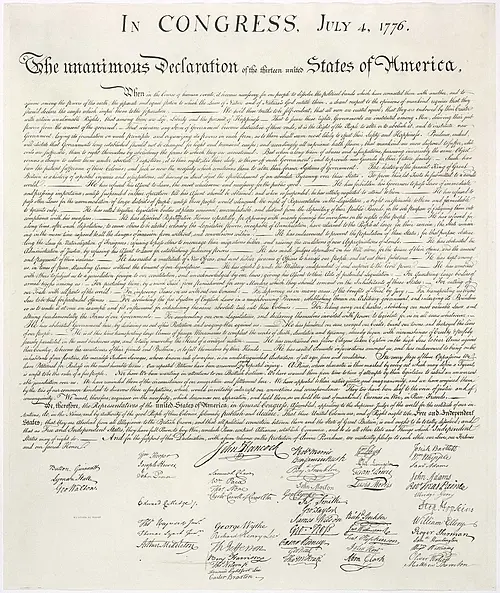
That is why the legal work behind independence matters.
Freedom needed passion, but it also needed precision.
The Declaration Was Not Shaped by One Profession Alone
The Declaration of Independence was not the work of lawyers alone. It required writers, statesmen, printers, merchants, physicians, farmers, military leaders, and many others who helped move the colonies toward independence.
But lawyers held a unique place in that story.
According to the American Bar Association, 25 of the 56 signers of the Declaration of Independence were lawyers. The ABA’s Declaration 250 initiative highlights that fact as part of its broader effort to recognize the role of lawyers in the establishment of the nation and their continuing role as civic leaders, problem solvers, and community servants.
25 of the 56 signers of the Declaration of Independence were lawyers.
That number is more than a historical footnote. It reveals something important about what independence required.
The founding generation needed people who understood rights, authority, risk, consequences, and the power of language. They knew that words on a page could become commitments, and that once ideals are declared, they must be structured, protected, interpreted, and defended.
Lawyers were not just present at the founding. They were part of the work of turning belief into a framework a nation could stand on.
Freedom Needed More Than Ideals
It is easy to remember Independence Day as a moment — a date, a signature, a celebration.
But the deeper story is that freedom did not mean the work was finished.
In many ways, it meant the harder work had to begin:
Building laws
Creating systems
Protecting rights
Resolving disputes
Defining authority
Challenging power
Helping a new nation live up to the principles it had declared
The words drafted on Jefferson’s desk could not protect anyone by themselves.
They needed institutions, courts, agreements, advocates, and systems. They needed people willing to do the careful, often unseen work of making those words matter in real life.

Freedom may begin with conviction, but it survives through structure.
The Signatures Were Not the Finish Line
Imagine the Declaration moving beyond Jefferson’s desk — from draft to debate, from debate to revision, from revision to adoption, from adoption to signatures.
Each step added weight.
The document was no longer a private draft on a writing surface. It had become a public commitment.
But even then, the signatures were not the end of the story. They were the beginning of a longer responsibility.
After independence came the hard work of building a country governed by laws, not only by ambition — a country where rights would have to be argued, tested, interpreted, expanded, and protected over time.

That work was never going to be simple.
It would require disagreement, judgment, and courage. It would require people who could translate broad principles into practical protection.
That is the work lawyers have been connected to for generations.
250 Years Later, the Desk Looks Different
Today, most lawyers are not drafting founding documents on a portable desk in Philadelphia.
The desk looks different now.
It may be a conference room table, a laptop, a client file, a courtroom bench, or a kitchen table where a family is trying to make sense of what comes next.
It may be a late-night email, a draft agreement, a bankruptcy petition, an estate plan, a settlement offer, a contract review, a custody dispute, a business transition, or a difficult conversation with a client who is scared, overwhelmed, or unsure whom to trust.

The tools have changed, but the responsibility is familiar.
Lawyers still work with language. They still help people understand rights and obligations. They still create structure in moments of uncertainty. They still help people move through conflict, risk, and change.
For law firm owners, that work carries an even greater responsibility.
You are not only practicing law. You are building and leading the organizations through which that work gets done.
What Independence Day Reminds Law Firm Owners
For law firm owners, Independence Day can be more than a holiday weekend or a patriotic message.
It can be a reminder of what the legal profession has always represented at its best:
Clarity when the stakes are high
Structure when circumstances feel unstable
Guidance when people do not know what to do next
Protection when rights, assets, families, businesses, or futures are on the line
Your daily work may not always feel connected to history.
It may feel like intake calls, staffing issues, billing questions, client deadlines, court filings, document reviews, team meetings, vendor decisions, and long days that few people outside the profession fully understand.

But that work matters.
Preserving a nation is not only done in historic moments. It is also done in the ordinary, disciplined work of helping people understand where they stand and what steps they can take next.
The Legal Work Behind Independence Still Continues
Two hundred and fifty years after the Declaration of Independence, the lesson is not only that lawyers were present at the beginning. It is that the work they helped begin still continues.
The ABA’s Republic at 250 programming describes the legal profession’s role as one of building, interpreting, and defending the rule of law from the founding era to the present
day.
Every generation has to decide whether words like rights, liberty, justice, responsibility, and due process will remain abstract ideals or become lived protections.
That does not happen automatically.
It requires people, systems, language, and leadership — lawyers willing to carry the weight of problems that are often complicated, emotional, urgent, and deeply personal to the people involved.
That is why the legal profession still matters.
From Jefferson’s Desk to Yours
Jefferson’s portable desk is remembered because of what was written on it.
But the deeper lesson is not really about the furniture.
It is about the work surface.
The place where thought became language. Where language became commitment. Where an idea had to become clear enough to carry forward.
Every lawyer knows something about that kind of work:
The blank page
The careful draft
The difficult revision
The client whose future depends on getting the details right
The quiet responsibility of knowing that words can change outcomes
Today, that work continues on different desks across the country — in law offices, courtrooms, conference rooms, and home offices, in firms large and small.
Thank You!
This Independence Day, we simply want to say thank you — to the lawyers and law firm owners who continue the careful, difficult, and necessary work of helping people understand their rights, navigate uncertainty, and move forward with confidence.



Comments